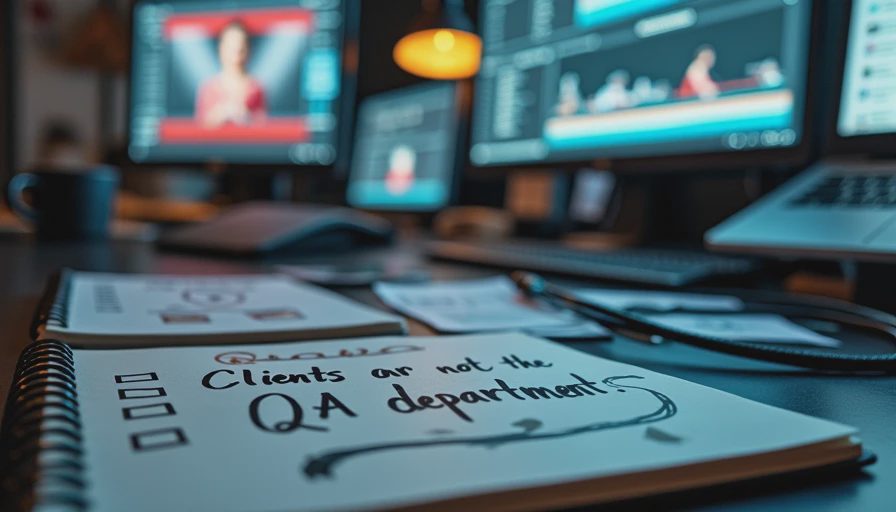
The fastest way to damage trust in an AI video pilot is to put unfinished work in front of the client and hope they will sort out what is still broken.
I have seen it happen more than once. A team generates a set of strong-looking takes. Internal enthusiasm is high. The review deck is built quickly. The client is invited to “take a look and tell us what you think.” What follows is not a focused creative conversation. It is an unplanned quality-assurance session in which the stakeholders become the first people to discover the motion glitch, the logo drift, or the revision limit that the team never tested.
Clients are not the QA department. Treating them that way teaches them that the process is still exploratory and that every note may restart the clock. Confidence drops. The next review becomes more cautious. The pilot starts to feel like a science experiment instead of production work.

There is a cleaner way to show early AI video tests. It requires more discipline before the meeting and less improvisation during it.
The Core Principle
Never show a take externally until the team can answer three questions in writing:
What is this take intended to prove or disprove?
What is already locked and what remains flexible?
What happens when the most likely note arrives?
If those answers are missing, the take is still internal. Showing it turns the client into the discovery mechanism.
A Practical Structure for External Test Reviews
I use the same simple structure for every early client-facing session involving Seedance 2.5 or similar tools.
1. State the Test Conditions Up Front
Open the review by saying exactly what the session is and is not.
Example language I have used:
“This is a controlled generation test under specific references and settings. We are evaluating product consistency, motion usability, and revision path—not presenting final deliverable footage. Everything you see carries a clear mark and a stated revision limit.”
The statement takes thirty seconds. It prevents the rest of the meeting from being spent recalibrating expectations.
2. Show Only Marked Takes
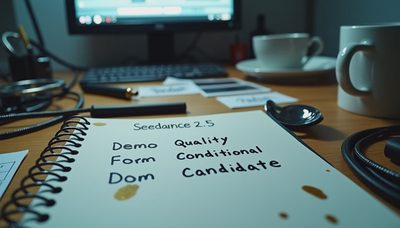
Demo-Quality takes stay internal. Only Conditional or Candidate takes appear in the deck, and every Conditional take carries its short revision-scope note.
This single filter removes most of the “we didn’t notice that until the client pointed it out” moments. If a take still has obvious artifacts or an untested revision path, it does not belong in the external conversation yet.
3. Lead With the Question You Want Answered
Do not open the floor with “What do you think?” Open with the specific decision the test was designed to support.
Examples:
“Does the product lock hold clearly enough at the key moment for this brief?”
“Is the motion usable for the cut points we already know we need?”
“Given the stated revision limits, is this direction worth continuing?”
A focused question keeps the discussion on the purpose of the test instead of turning every frame into an open bug hunt.
4. Keep the Scope Statement Visible
When a note arrives, the scope statement is already on the table. The conversation becomes “this change sits inside the flexible category” or “this change would require a new generation cycle,” not a scramble to invent an answer under pressure.
Clients respect clear boundaries more than optimistic flexibility that later collapses.
5. Separate Direction Feedback From Technical Discovery
If a stakeholder notices a technical issue that the team should have caught, acknowledge it, mark it, and move it to the internal list. Do not let the entire review become a technical debugging session. The creative direction conversation and the process-improvement conversation are both valuable; they should not be mixed in real time.
What Changes When This Structure Is Used
Teams that follow it report three consistent results.
First, client conversations stay shorter and more decisive. The stakeholders are not being asked to perform unpaid QA, so they focus on the decisions that actually belong to them.
Second, internal standards rise. Knowing that only marked takes will be shown forces better selection and earlier testing of revision paths.
Third, trust compounds instead of eroding. When the first note is handled inside the stated limits, the next review starts from a stronger position.
I have watched the opposite pattern as well. An unmarked, lightly tested take goes into the deck. The client finds the weak point. The team spends the remainder of the meeting explaining process rather than advancing the work. Recovery takes longer than the original generation cycle.
A Calibration Story
A mid-sized team I worked with earlier this year had been showing almost every coherent generation to the client under the banner of “transparency.” The reviews were long, the notes were scattered, and every session felt like a new discovery process.
We installed the structure above for the next pilot. Only two takes were shown—one Conditional with an explicit background-simplification limit, one Candidate after a local logo test. The opening statement took less than a minute. The focused question was about product readability at the hold. The client note that arrived sat inside the stated flexible category and was resolved without drama.
The entire review was over in twenty minutes. The producer later said it was the first AI-related client meeting that felt like a normal production conversation instead of a technical support call.
The dog was not invited. Morgan, after hearing the story, said the same rule she uses with her own stakeholders: never ask someone to find the problems you should have found yourself. Correct again.
What to Do Before the Next Client Review

Apply the Demo-Quality / Conditional / Candidate marks rigorously.
Write the three-question test for every take that might be shown.
Prepare a one-sentence opening statement of test conditions.
Decide the single focused question the review is meant to answer.
Keep the revision-scope note visible and ready.
Practice the difference between “this is still internal” and “this is ready for a decision.”
The pictures can be strong enough to tempt a team into early exposure. The handoff still requires the discipline of knowing what the client is actually being asked to do.
A test review should produce a clear decision or a clear next experiment. It should not produce a surprise list of issues the team should have already known about.
If it cannot survive the handoff, it is not a workflow yet.


No letters yet — be the first to write.